

Healthcare data exchange has grown with the help of standards such as EDI X12 for financial transactions, HL7 v2 for clinical messaging, DICOM for medical imaging, and NCPDP for pharmacy data. These standards are still essential for healthcare operations and have helped digital healthcare expand in clinical, administrative, and financial areas.
As healthcare records became digitized, the need for healthcare information to be exchanged in a structured and standardized manner became increasingly important. This is where Fast Healthcare Interoperability Resources (FHIR), developed by Health Level Seven (HL7) International, comes in. FHIR brings together proven interoperability principles and modern web technologies to make healthcare data easier to exchange without compromising clinical integrity. As a result, it has become the foundation for connected digital health ecosystems.
The Evolution of Healthcare Interoperability
Healthcare interoperability standards transformed clinical, administrative, and financial workflows. Many continue to power mission-critical systems across healthcare organizations today. Combining key concepts from HL7 v2, HL7 v3, and CDA with modern web technologies, FHIR was designed to simplify implementation without sacrificing information integrity.
The result is a standard that is easier to implement, more developer-friendly, and better suited for today's interconnected healthcare landscape.
Understanding the FHIR Standard
FHIR is structured around the concept of Resource and Implementation Guides (IGs).
- Resource functions as the fundamental unit for healthcare information exchange. Each Resource represents a specific healthcare concept, such as Patient, Observation, Encounter, Claim, or Coverage. Resources define the structure, terminology, and constraints to ensure consistent representation of healthcare information across systems. This modular architecture allows organizations to exchange standardized, reusable data across different applications. While Resources provide the foundation, real-world implementations often require additional business rules and regulatory constraints. Profiles address these by customizing Resources for specific use cases and specifying mandatory fields, terminology bindings, and validation requirements.
- Implementation Guides (IGs) contain multiple profiles, terminology definitions, extensions, and implementation requirements. These guides provide organizations with detailed specifications to ensure consistent interoperability across healthcare ecosystems.
Why Healthcare is Accelerating FHIR Adoption
Although FHIR was introduced in 2014, adoption initially progressed slowly. Many healthcare organizations continued relying on proven interoperability standards while evaluating FHIR's maturity and practical applications.
The standard itself has not changed dramatically. What has changed is the healthcare environment.
Regulatory Momentum: Among these drivers, regulatory action from the Centers for Medicare & Medicaid Services (CMS) has been particularly influential. The diagram explains this in detail:
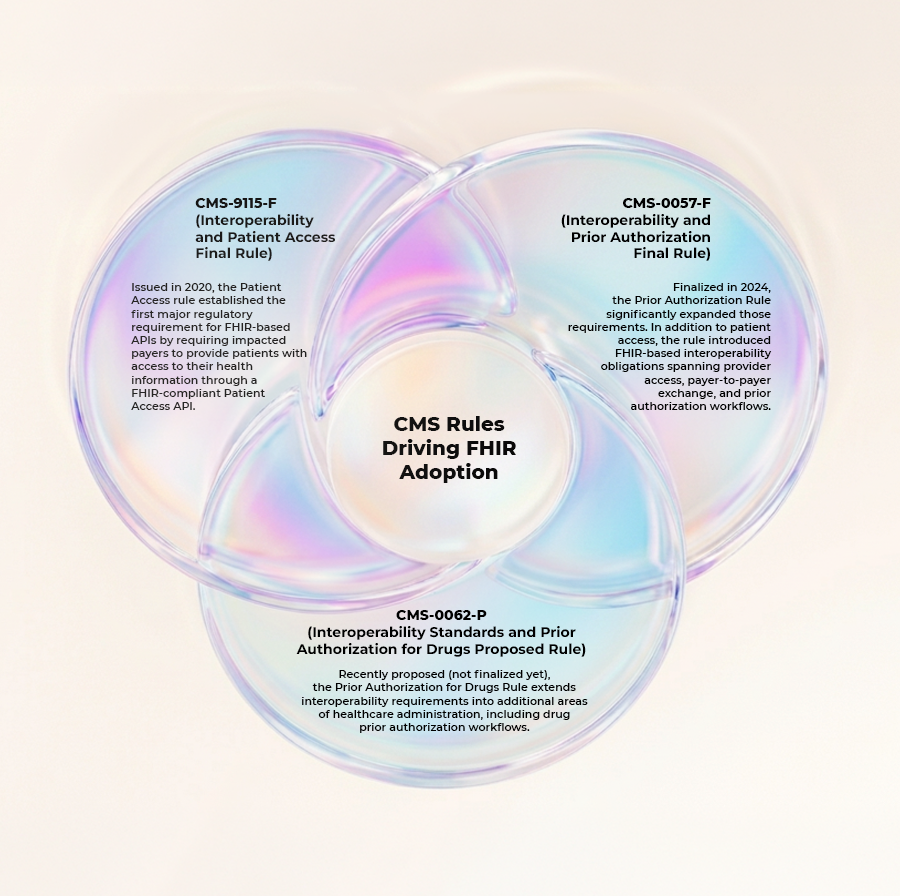
Beyond CMS regulations, FHIR is driving interoperability initiatives such as Trusted Exchange Framework and Common Agreement (TEFCA) by enabling standardized, API-based data exchange across Qualified Health Information Networks (QHINs).
The momentum extends beyond the United States. In Australia, the Australian Digital Health Agency (ADHA) has set out its National Healthcare Interoperability Plan 2023–2028, making FHIR-based interfaces a key part of the country’s future digital health system. Projects such as AU Core and the update of My Health Record show this shift. FHIR interoperability is quickly becoming the standard for sharing healthcare data.
For healthcare organizations worldwide, FHIR has moved from a mere modernization effort to a key requirement for interoperability. This shift brings a clear challenge: how to fit FHIR into current systems.
Legacy Systems, Modern Standards, and the Gap Between them
Healthcare organizations do not need to replace their current technology systems to adopt FHIR. Many clinical, financial, and administrative workflows still rely on technologies that have supported healthcare for years, and in some cases, decades.
Standards like HL7 v2 still handle clinical messaging, and EDI X12 is essential for claims, eligibility checks, remittances, and other financial tasks. SFTP file exchanges, proprietary interfaces, and custom integrations are also common throughout healthcare systems.
These technologies are more than just old systems. They continue to support key business and clinical processes.
The main challenge is linking these established systems with modern interoperability standards. Organizations are typically required to introduce FHIR capabilities while continuing to support existing interoperability mechanisms. Data often originates in legacy formats, moves through established workflows, and must ultimately be transformed into FHIR-compliant resources to support modern interoperability requirements.
In practice, healthcare data often starts in legacy formats, moves through existing integration pipelines, and needs to be converted into FHIR resources before modern applications can use it.
This is where FHIR implementation becomes complex. Success is less about replacing legacy systems and more about bridging the gap between existing standards and modern, API-first healthcare systems. Organizations that see FHIR as an integration strategy, not just a technology replacement, are better able to modernize without disrupting important healthcare operations.
The Future of FHIR
After over a decade of evolution, FHIR has matured into the industry's preferred interoperability standard. Implementation Guides cover clinical, administrative, and financial domains. Organizations are advancing pilot projects toward enterprise-wide adoption, and governments are integrating FHIR into national interoperability strategies.
The industry no longer questions FHIR’s implementation. The focus is now on effective implementation, balancing legacy systems, operational continuity, regulatory compliance, and future scalability. Organizations that invest in a well-planned interoperability strategy today will be better prepared to support emerging care models, AI-enabled healthcare applications, patient engagement platforms, and cross-organizational collaboration.
FHIR integration is no longer just another healthcare standard. It is becoming the foundation for future healthcare information exchange. Organizations ready to advance should prioritize effective implementation support.
How Cybage Helps Healthcare Organizations Accelerate FHIR Adoption
Implementing FHIR successfully requires more than technical expertise. Organizations must modernize legacy systems, align with evolving regulatory frameworks, and establish scalable interoperability architectures that support long-term digital transformation.
Cybage partners with healthcare organizations across the interoperability journey by combining deep healthcare domain expertise with cloud, API, AI, and platform engineering capabilities.
Our FHIR services include:
- FHIR Enablement & Modernization
- Cloud-based FHIR enablement of legacy systems and standards.
- AI-assisted mapping and conversion of legacy data to FHIR resources.
- FHIR API & Application Development
- Cloud-native FHIR APIs and applications built for scale.
- AI-powered interoperability, including intelligent data matching and validation.
- Implementation Guide & Standards Enablement
- Implementation of frameworks such as Da Vinci, US Core, AU Core, and CARIN Blue Button.
- Configuration of profiles, extensions, and implementation guides for business and regulatory needs.
- FHIR Compliance & Regulatory Readiness
- Cloud-based FHIR compliance enablement for CMS, Australia's national interoperability roadmap, and other evolving mandates.
- AI-driven monitoring for ongoing interoperability and compliance readiness.
Our approach enables healthcare organizations to modernize incrementally, preserving existing investments while building a future-ready interoperability ecosystem. That approach supports the broader goal of transforming healthcare interoperability with confidence.
Read our case study to discover how Cybage helped a leading digital health solutions provider modernize interoperability with FHIR and achieve compliance.
Building Future-Ready Healthcare Interoperability
FHIR is transforming how providers, payers, pharmacies, and digital health platforms exchange information. As connected care evolves, organizations need interoperability strategies that go beyond compliance to enable scalability and operational efficiency.
Cybage combines healthcare expertise with cloud, interoperability, and AI capabilities to accelerate FHIR adoption while reducing implementation complexity and preserving existing investments.
Connect with us to learn how we can help you build a future-ready interoperability ecosystem.
Authored by
Divya Krishnan
Business Analyst, Cybage